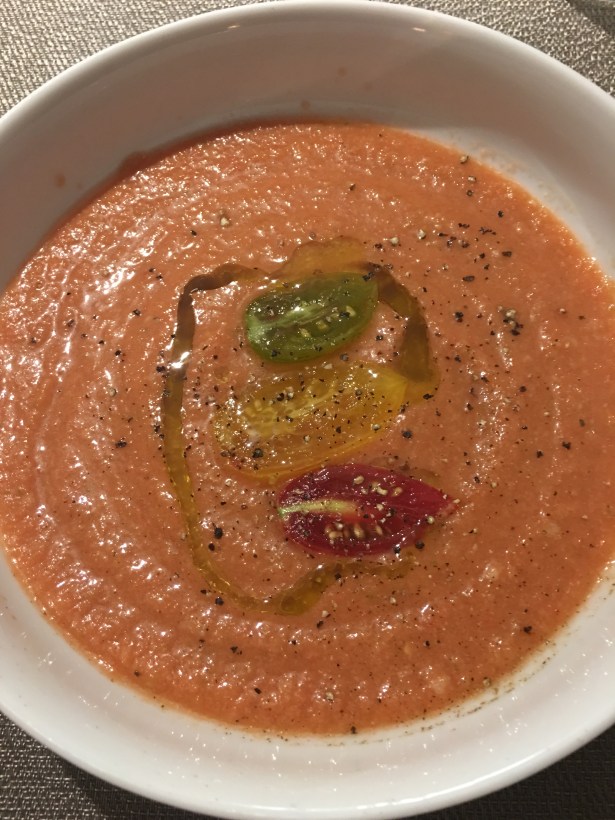
In southern Spain–Andalusia, the gazpacho homeland–gazpacho is always smooth and quite liquid. It’s traditionally drunk from a glass. In fact, Spanish supermarkets sell gazpacho and salmorejo (its tomato-garlic-bread cousin) in containers, like juice. It’s a wonderful way to hydrate after touring in the hot summer sun. I make a basic traditional Spanish gazpacho. It looks like A LOT of steps, but it’s really not and you’re doing everything with the blender or processor and a cutting board. Once you do it a couple of times, it’ll be easy-peasy.
There is some disagreement about using bread crumbs. Some say that only salmorejo should have bread, while other authorities say that gazpacho can too. I like to use bread because it gives the concoction more body, so it’s spoon-able, because I like to eat it as a first course. If I make a chopped version, I wouldn’t use bread.
There are many schools of thought on chopping gazpacho versus blending or food processing. I always used to chop mine until I went to Spain for the first time–there it’s always smooth. While the smoother version is probably a modern invention, it’s not absolutely clear: Spaniards have never been afraid to make smooth and puréed things with their mortar and pestles (see romesco sauce as one example).
I use either the blender or the food processor. The food processor version has more body, while the blender makes it more fluid. Either one is delicious.
Basic gazpacho
Ingredients:
Half loaf baguette or half-size baguette
One large tomato, cored and in quarters
One large clove garlic, peeled
One cubanelle pepper or green pepper (never red or yellow), seeded and stemmed.
One small, sweet, onion, peeled and in quarters
One cucumber, peeled and quartered
Salt
Olive oil
Sherry vinegar
Cold water or crushed ice
Make bread crumbs: Slice baguette and toast in a 300F oven for about 20 minutes, flipping once. You want the bread to dry out and get firm, but not really color. I never really time this, but just watch it every 5-10 minutes because my bread slices might be thin one day and not another, or the baguette wetter or drier.
Let slices of bread cool and pulse in blender or food processor. I typically like to make them about the size of smallish panko, like very small pebbles, because this makes enough to keep and use for other things. However, if making them in the processor, be sure to grind around 3/4 cup of them rather fine–like coarse sand. The processor won’t purée them a lot and you want the bread to disappear rather than stay visible in your soup by the end.
Dump out the bread crumbs into a small container with a lid. If you’re going to purée further for the processor, keep those finer ones separate. Use leftovers in all the delicious ways you can use breadcrumbs–atop casseroles, as light breading for grilled or broiled fish, or in a spaghetti sauce with lemon, garlic, and chile.
Make the soup: I add things in the order shown below when using the blender. After each group, blend away for a while. Things don’t have to get perfectly puréed at each stage because you can let it whirl at the end until it’s smooth. In the processor, I just put everything in at once and pulse it until things are looking smooth. The processor version never gets as smooth and always maintains more body, especially from the tomato flesh.
Here’s the order for blenders:
1-Garlic clove and pepper
2-Cucumber and onion
3-Tomato
The directions are the same for both blender and processor from this point forward.
Once things are blended to your liking (it will be pinky-orange, somewhat) add some bread crumbs. I probably add a scant quarter cup at a time–it’s okay to play around with the amount until it feels like you want it to feel. Then, add a solid amount of salt. I would start with a teaspoon and then add by maybe 1/2 or 1/4 teaspoons. The Spanish are not afraid of salt, but you should do this to your own liking. It’s important to salt AFTER the breadcrumbs because the baguette contains salt.
A really important thing to add is your nicest, most flavorful olive oil and sherry vinegar. Use sherry vinegar, which has a hint of sweetness, so you can avoid sugar (which you will see in some recipes). I add this by teaspoons, whirr, and then add a bit more. You want a very faint hint of sweet vinegar with a teeny-tiny bit of bite. Some authorities call for 1/4 cup olive oil for this amount of vegetables. I don’t measure mine, but I don’t think I use that much. I just dump a bit in (maybe a tablespoon), whirr, and then look and taste. Usually I add more, maybe another tablespoon or even more. You want the soup to turn quite shiny, but be mindful: you want the oil to provide a round mouthfeel that lets you experience the other flavors rather than taste the oil. (Chemically, fats and oils convey flavors which is why the oil is key and makes this taste wonderful and not watery.)
At the very end whirr in a bit of crushed ice or some cold water. Maybe 1/3 of a cup of ice or 1/4 cup of water. This cools the soup and the water helps smooth out any errant breadcrumbs and just makes the soup somehow become right. I like to chill it for a while, before we enjoy it. Some swear that eating it the next day is better, but who can let it wait?
 Michael Coventry